
Industry opinion article By Sergei Shagalov
Over the past several years, Batumi has emerged as one of the region’s most visible gaming destinations. Casinos attract international visitors, create employment, and generate demand for hotels, restaurants, transportation, retail, and other parts of the urban economy. As the market matures, however, the role of government must also evolve. The objective should no longer be simply to collect the highest possible payment from every gaming table. It should be to create an ecosystem in which the growth of the casino industry contributes directly to tourism, investment, service quality, and sustainable tax revenue.
A Casino Is More Than a Taxpayer
When an international guest comes to Batumi to gamble, the economic value of that visit extends far beyond the gaming floor. The visitor purchases an airline ticket, books a hotel room, uses local transportation, dines in restaurants, shops, and often stays in the city for several days. Gaming tourism is especially valuable outside the summer season, when traditional resort demand declines. For this reason, the economic contribution of casinos should not be measured only by the taxes paid directly by operators. The wider impact includes hotel occupancy, employment, payroll, local procurement, restaurant revenue, transportation services, supplier taxes, infrastructure investment, and the international promotion of Batumi. When a casino closes because its regulatory burden no longer reflects its commercial reality, the government does not lose only one source of tax. It loses the entire chain of economic activity created by the visitor.
Regulation Shapes Business Behavior
Every tax system creates incentives. A fixed tax on each gaming table is easy to administer: the table exists, so the operator pays. Yet the number of tables says little about the quality of service, the scale of investment, the volume of tourism created, or the operator’s contribution to the city. The same fixed payment may apply to two fundamentally different businesses. One may invest in a hotel, restaurants, transportation, professional employees, security, and international marketing. The other may create little tourism value and leave little economic benefit in Batumi.
For a smaller, commercially responsible casino, a fixed tax becomes a significant burden, particularly during the low season. For an operator moving very large sums of money, the same payment may be insignificant relative to its financial flows. A table tax does not cause money laundering, but it does little to distinguish between a legitimate tourism business and an operation whose real purpose may be the movement of opaque funds. It also fails to reward operational excellence. The government receives the same payment regardless of whether management attracts guests, delivers strong service, encourages repeat visits, and creates revenue for the hotel and the wider city.
Focus on the Money Entering the Casino
A more constructive alternative would be to measure and control qualified drop: the new money introduced by a guest into the gaming system. Drop should not be confused with betting turnover. The same funds may be wagered repeatedly, causing turnover to become many times larger than the original amount brought into the casino. Qualified drop should include new cash deposits, bank transfers, funded gaming accounts, paid credit instruments, and money exchanged for chips either at the cage or at the table. Internal chip movements, repeated use of previously recorded money, technical currency exchanges, canceled transactions, and unused deposits returned to the guest should not be treated as new drop.
The logic is straightforward: when a casino accepts money, the government should be able to identify its source, record its entry into the gaming system, and apply a clearly defined tax. This creates a more transparent base than one derived solely from accounting profit. Reported profit can be reduced through bonuses, commissions, management fees, related-party contracts, and other accounting mechanisms. The original receipt of money is far more difficult to conceal when it is recorded simultaneously through the cage, the player account, surveillance, banking information, and regulatory reporting.
Why a Drop-Based Tax Could Improve Service
In my experience across multiple gaming markets, a professionally managed casino can retain approximately 25–30% of the initial money introduced by guests during their visit. This is not the mathematical house advantage of an individual game. It is the casino’s actual retention of the guest’s initial funds across the entire customer journey. That outcome depends heavily on management.
How quickly was the guest registered? Was the right table open? How long did the buy-in take? Did the player have to wait for a payment? Was a host available? Was the service attentive without becoming intrusive? Did the guest feel comfortable enough to remain for another hour, return later that evening, or extend the trip?
These details determine how effectively a casino converts drop into gaming revenue. If a casino retains 25% of drop, a tax equal to 20% of gross gaming revenue is equivalent to approximately 5% of the original drop. At a 30% retention rate, the equivalent is 6%

A drop-based tax in this range could therefore be broadly comparable to a 20% tax on GGR under these operating assumptions. But the incentives would be fundamentally different. Under a GGR-based model, an operator may focus on reducing reported taxable revenue. Under a drop-based model, management must become more effective at converting each accepted dollar into legitimate gaming and tourism revenue. This encourages faster operations, better staffing, stronger service, smarter loyalty programs, improved hotel integration, and more repeat visits. The government receives a transparent share of the incoming funds, while the operator’s financial performance depends on managerial competence.
Reward Economic Contribution
A drop-based tax does not need to be identical for every operator. A base rate could be reduced according to the casino’s verified contribution to Batumi’s tourism and urban economy. Relevant factors could include capital investment, hotel construction and modernization, formal employment, payroll, employee training, procurement from independent Georgian suppliers, foreign guest nights, low-season tourism, investment in surveillance and AML systems, international marketing, and the absence of serious regulatory violations.
The key word is verified. Tax incentives should not be based on any expense declared in financial statements. Otherwise, operators could inflate rent, consulting contracts, marketing costs, and management fees through related companies. The system should recognize only measurable economic value that remains in Georgia: salaries, taxes, genuine local procurement, confirmed capital investment, professional education, and demonstrable tourism flows.
“The more money a casino accepts, the more transparent it must become. The more value it leaves in the local economy, the lower its tax rate may be.”
License the Management, Not Only the Casino
No tax model can work without the personal accountability of those making the decisions. Owners do not personally supervise cage transactions, player credit, discounts, surveillance, or gaming procedures. These responsibilities are carried out by general managers, casino directors, chief financial officers, AML officers, compliance leaders, surveillance directors, security executives, and gaming managers.
If only the company is licensed, an executive may risk little more than losing a job. A manager dismissed from one property may simply move to another. Personal licensing changes the balance. A licensed executive understands that the investor is risking capital, while the manager is risking the right to remain in the profession.
If a senior employee knowingly participates in money laundering, falsifies drop records, manipulates reporting, or violates gaming procedures, the consequence should not be limited to dismissal. The individual should also risk losing a professional license. A person who loses that license for a serious violation should not be able to cross the street and continue the same practices at another casino.
Personal licensing protects every stakeholder. The government gains an identifiable, accountable professional. Investors gain managers who have passed suitability and background checks. Executives gain a legitimate basis for refusing unlawful instructions. Guests receive a safer and more credible gaming environment. A licensed manager must be able to tell an owner:
“I cannot carry out this instruction. It violates regulatory requirements and places my professional license at risk.”
Residents Must See the Benefit
Any gaming policy ultimately depends on public legitimacy. Residents should not see only casino signs and hear only about operator profits. They should understand how the industry improves their own economic environment. A healthy gaming ecosystem should create stable employment, professional education, higher wages, demand for local suppliers, stronger hotels and restaurants, year-round tourism, improved infrastructure, higher municipal revenue, and a stronger international profile for Batumi.
A defined share of gaming-related revenue could also support tourism infrastructure, urban improvement, professional education, responsible gaming programs, cultural initiatives, and the international promotion of the city. When residents can see the connection between the industry and visible improvements in their daily environment, the legitimacy of the entire sector increases.
From a Collection Model to a Development Model
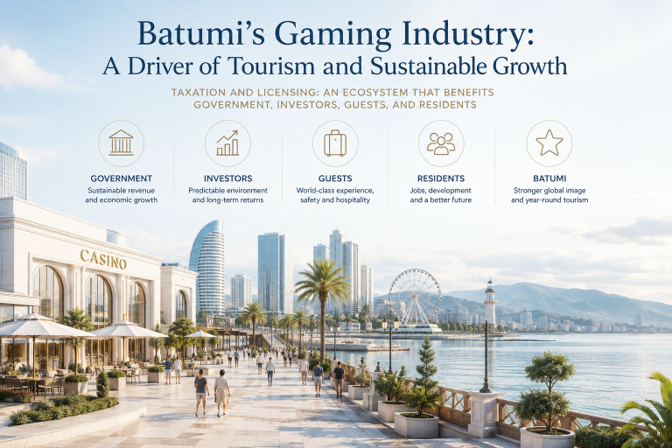
The future of Batumi’s gaming industry should not be framed as a conflict between the government and investors. Their long-term interests are aligned. The government needs sustainable tax revenue. Investors need predictable rules and a viable operating model. Guests need safety, trust, and quality. Residents need jobs, income, and better infrastructure.
A modern ecosystem would be built on four principles: transparent control of qualified drop, taxation that rewards operational efficiency, personal licensing of key managers, and incentives tied to measurable economic contribution.
Under such a model, casinos would no longer be treated merely as isolated sources of tax. They would become part of a broader tourism strategy—one capable of extending the season, attracting international capital, raising service standards, and creating value throughout the city.
The objective should not be the highest possible tax today. It should be the greatest sustainable value for Batumi over the next several decades.
Source: LinkedIN