
Over the past fifteen years, Batumi has transformed itself into one of the fastest-growing gaming destinations in the Black Sea region. Rapid tourism growth, the arrival of international hotel brands, and a favourable investment climate attracted substantial capital and helped establish the city as a major casino hub.
Today, however, the market is entering a fundamentally different stage of development.
Alongside rising gaming taxes, stricter regulatory requirements, and increasing operating costs, Batumi now faces a new external challenge. The launch of integrated casino resorts in the United Arab Emirates and the legalization of casino gaming in Azerbaijan are reshaping the competitive landscape. The competition for premium customers is no longer confined to the Black Sea region
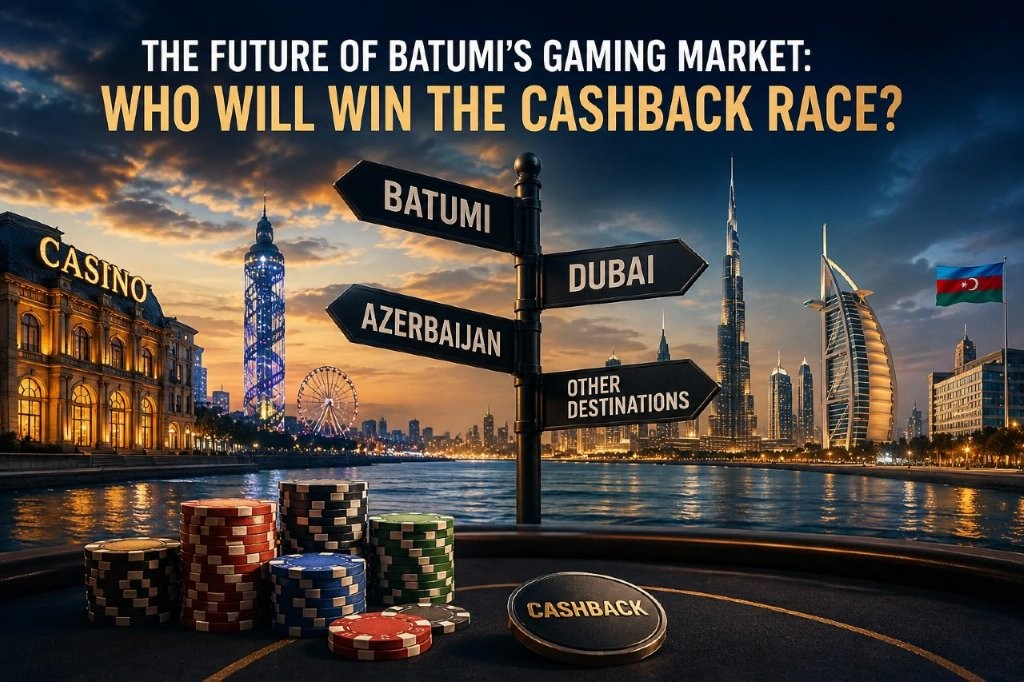
Only a few years ago, a regional VIP player might have compared several casinos within Batumi. Today, that same customer can choose between Batumi, Dubai, Azerbaijan, and several other emerging gaming destinations. These new projects offer world-class hospitality, internationally recognized hotel brands, large-scale entertainment complexes, and marketing budgets that continue to grow.
The question is no longer how quickly Batumi's gaming industry can expand.
The real question is which operators will remain profitable in this new environment.
The Market Has Reached a Turning Point
Every rapidly growing gaming market eventually reaches maturity.
Batumi now appears to have reached that stage.
The number of casinos, gaming tables, and slot machines has expanded far more rapidly than the pool of economically sustainable customers. At the same time, gaming taxes, compliance costs, labor expenses, and regulatory requirements have all continued to increase.
Recent events reflect this reality. During 2025, several major casinos either ceased operations or changed management. Regardless of the specific reasons behind each case, the message is clear: the traditional growth model based on adding more gaming equipment while continuously expanding into broader customer segments is approaching its economic limits.
Adding more tables no longer guarantees higher profits.
The Cost of a Player Is Becoming Unsustainable
Perhaps the greatest challenge facing the market today is the rapidly increasing cost of acquiring and retaining players.
Competition has evolved into an aggressive race of progressive cashback programs, complimentary flights, luxury accommodation, airport transfers, fine dining, and increasingly generous VIP incentives.
At the same time, a substantial share of premium customers is controlled by junket operators receiving significant commissions for player acquisition.
None of these tools is inherently problematic. Cashback programs, junkets, and loyalty incentives remain legitimate components of modern casino marketing.
The problem begins when they stop supporting a strong product and instead become the product itself.
Once cashback percentages and junket commissions become the primary competitive advantage, the economics of the business begin working against the operator.
Lessons from Kazakhstan
Kazakhstan has already experienced a similar cycle.
As taxes increased and competition intensified, operators gradually shifted their focus away from customer experience and toward increasingly aggressive financial incentives.
By the early 2010s, promotional campaigns advertising cashback offers of 30% to 70% had become commonplace. Players became increasingly sophisticated, learned how to optimize loyalty programs, shortened their gaming sessions, and strategically moved between casinos to maximize promotional value.
Customer acquisition costs continued to rise while profitability steadily declined. Eventually, the market consolidated dramatically, reducing the number of gaming operators almost three-fold.
Although Batumi differs from Kazakhstan in many respects, the underlying economic mechanisms are remarkably similar. For that reason alone, Kazakhstan's experience deserves careful attention.
The Real Problem Is Not Marketing
The underlying issue is not marketing alone:
· Almost any operator can pay for flights.
· Almost any operator can provide complimentary hotel rooms.
· Almost any operator can increase cashback.
· Almost any operator can offer higher commissions to junket partners.
All of these initiatives can be copied almost overnight. What cannot be copied is organizational culture:
· No operator can simply purchase genuine hospitality.
· No operator can instantly build trust.
· No operator can create an engaged, professional team within a few months.
This is why leadership (and not marketing budget) is becoming the industry's most valuable competitive asset.
Many casino operators still focus primarily on operational control and short-term financial indicators while investing relatively little in leadership development, middle management, employee engagement, or service culture.
As a result, financial incentives increasingly compensate for weaknesses in the customer experience itself.
Cashback Never Replaces Value
When service quality declines, when casinos become difficult to distinguish from one another, and when employee engagement weakens, the easiest response is often to increase cashback or introduce additional incentives.
But cashback does not solve the underlying problem. It only postpones it.
In practice, operators may end up using financial incentives to compensate for weaknesses in service quality, management culture, and the overall guest experience. Long-term value is created elsewhere: through strong leadership, professional management, motivated teams, memorable hospitality, trust, and consistently high service standards.
These are competitive advantages that cannot be replicated simply by increasing promotional budgets.
Who Will Win Tomorrow?
The next generation of market leaders will not necessarily be those offering the highest cashback percentages.
Nor will they be those operating the largest gaming floors.
The winners will be those capable of creating genuine hospitality value: operators who understand that people ultimately return because of people, not because of promotional offers.
Cashback may encourage a guest to visit once.
Leadership, service, trust, and atmosphere are what bring them back for years.
Conclusion
Batumi's gaming industry is entering an era where leadership, organizational culture, operational efficiency, and analytical decision-making will become more important than expansion alone.
The era of competing primarily through financial incentives is gradually coming to an end.
The operators that survive the next decade will not be those that compensate players for the largest losses.
They will be those that create experiences worth returning for.
Ultimately, the future of Batumi's gaming market belongs not to those who spend the most acquiring customers, but to those who create the strongest reasons for customers to remain loyal.
Author: Sergei Shagalov